While 78% of College Students Believe the
Country is On The Wrong Track
A Record Number – 79% Believe They Can Make A Difference
by Voting and Participating in the Democratic Process

According to Results from 25th Annual
Panetta Institute Youth Civic Engagement Survey

In the Panetta Institute’s 2026 nationwide survey of college students, the 25th year the survey has been conducted, results show students are deeply concerned about the future of the United States and their own personal prospects for economic security. A record 78% of students believe the nation is on the wrong track, a jump of 13 points from just last year. In another record high, 58% felt that American democracy was not currently working. Seventy-four percent say they are uncertain and concerned about the future of the country.

“Students are distressed and dissatisfied about the state of the nation,” said Institute Chairman Leon E. Panetta. “They see a democracy that is presently failing to function. They give elected leaders a failing grade and they are losing trust in core democratic institutions. However, as we approach the 250th anniversary of the American Revolution, our young people continue to believe in the spirit and promise of our Democratic ideals. They believe politics are relevant to their lives and a massive 79% believe they can make a difference by voting and participating in our democracy. In the coming midterms, it will be interesting to see what these frustrated but passionate young people do. At the Panetta Institute, we see this as a critical time for all of us to listen to the concerns of our youth and foster their faith in our democracy so that together we can protect it for the future.”

DEEP CONCERNS ABOUT AMERICAN DEMOCRACY PAIRED WITH LONG-TERM FAITH IN AMERICA’S IDEALS

The results of this year’s survey show a young population that continues to be deeply pessimistic about America today. A record high share of students (78%) believe that the country is off on the wrong track and do not believe that democracy in the United States is working well today (58%). Seventy percent express dissatisfaction with the current political leadership and a staggering 74% are concerned about America’s future. Further, students express deeply eroded trust in American institutions particularly in their ability to protect the electoral process. Just 41% report having high confidence in state government in conducting elections, and even lower have confidence in the court system resolving legal disputes related to elections (33%), and in the federal government ensuring free and fair elections (31%). The press and media also come out tarnished with only 34% of respondents reporting confidence in the news media’s coverage of elections.

Despite these powerful concerns, as we mark the 250th Anniversary of the American Revolution and the signing of the Declaration of Independence, students still believe in America’s promise and have not lost faith in the country’s founding ideals. Seventy-three percent of students say that America has succeeded in “achieving the ideals for which the country was founded.” Specifically students mentioned an increase in individual freedoms, economic growth and greater equality, among others, as achievements the nation had made since its founding.

A GENERATION READY TO TAKE ACTION:

Contrary to stereotypes, the survey shows a generation that is civically engaged, especially outside of traditional national politics. Overwhelmingly, college students are choosing engagement over apathy. Sixty-seven percent say that politics is relevant in their life. Thirty-seven percent express interest in running for federal elected office, the highest level recorded by the survey to date. Sixty-eight percent report that during their time in college they have been involved in serving their community. Seventy-nine percent believe that they can make a difference in their local community, up from 74% in 2018. Among those who say they can make a difference in their local community, they believe they are most able to bring change by: doing volunteer work for a group that helps those in need (81%); voting in state and local elections (79%); and volunteering with an organization that is concerned with a particular issue (79%).

TRUMP AND THE MIDTERMS – A COMING RECKONING?

With a full seventy-nine percent of students seeing the value of their constitutional right to vote, it is clear students will have a powerful impact on the midterm elections. Their responses show a strong swing in support for Democrats and suggest that their frustration with President Trump and his policies will impact Republicans on the ballot. Sixty-two percent of college students say that they are highly motivated to vote in the midterm elections, much higher than motivation in the 2022 (43%) and 2018 (46%) midterms. Fifty-four percent report they are following news about the congressional elections closely, a record high on this measure. By 63% to 24% college students prefer a generic Democratic candidate over a generic Republican – the highest margin recorded in the Panetta Institute survey going back to 2002. And by 66% to 20%, college students believe that the country will be better off if Democrats control Congress and provide checks and balances on President Trump and keep him from going too far, rather than if Republicans control Congress to help President Trump pass his agenda.

Across a series of issues, the majority of college students believe that President Trump is making things worse for the nation. Seventy-five percent of college students disapprove of the job Trump is doing as president, while just 25% approve. Majorities of college students say that President Trump is making things worse across nine areas that were measured, including the cost of living (64%) and immigration (60%).

As the Democrats look ahead to the 2028 presidential contest it might be of interest that when asked to respond to a list of leading Democratic and Republican individuals the two leading personalities were
Vice President Kamala Harris (48% total positive) and New York Mayor Zohan Mamdani (41% total positive) indicating the progressive mayor has made a strong impression on young voters.

DEEP ECONOMIC ANXIETIES CHANGE PERCEPTIONS ON THE AMERICAN DREAM

Economic pressure is the central lens through which students view politics and their futures. Financial concerns remain front and center with a disturbing amount of students suggesting the economy will get worse before it gets better. Fully 67% of college students say dealing with inflation and the cost of living is the most important issue for them personally. Only 29% say the nation’s economy is excellent or good, unmoved from last year. More alarming is that 53% believe that the nation’s economy will get worse over the next 12 months and 39% report that their family’s income is falling behind the cost of living. A record high of 78% now say that compared to their parents’ generation it is harder to achieve the American Dream, by 41% to 32% students believe that they will be worse off rather than better off than their parents. This all leads to continued pessimism about students’ own outlook after they graduate, a new record low of 58% say they are confident they will be able to find a job after graduation that is acceptable to them and, with another record high, 59% say they are worried about being able to afford health insurance. Eighty-six percent of students with student loan debt currently expect to have that debt upon graduation.

FOREIGN AFFAIRS
While the survey was conducted before the most recent peace agreement between the United States and Iran, students are deeply critical of President Trump’s foreign policy performance. Seventy percent believe the President has had a negative impact on America’s reputation in the world. A full 79% disapprove of his dealing of the war in Iran and 51% believe he has made the situation between Ukraine and Russia worse. One possible impact of these opinions is a deep decline in the level of confidence in the U.S. military, now down to only 39%.

Despite the fact that there are two current global conflicts, fifty-eight percent of students believe the problems their generation will face will be national in scope rather than international and a growing percentage would like to see the President focus on domestic issues. Thirty-nine percent believe the country should “become less active” in world affairs, a record for the survey.

AI CHANGES PERSPECTIVE ON THE FUTURE:

Students are both early adopters and cautious critics of AI, embracing its utility while fearing its consequences. This year’s survey marks the first time students take the negative view on the increased use of computers, robots, drones, and AI on the economy, with 54% now saying this is a bad thing, a 14-point jump from 2023. Seventy-nine percent of college students report using a chatbot, the first decline on this measure since the survey began tracking the issue in 2023. However, there continues to be growing acceptance of the use of AI, at least with their fellow students, as 67% now say that they know someone who has submitted work created by a chatbot as their own, up from 62% last year, with increases year over year since 2023.

Sixty percent of students are concerned that AI could threaten their job in the future.

Already, 26% of students say that AI has either caused them to switch majors (9%) or reconsider their course of study (17%) and 60% say they are concerned that AI could threaten their job in the future.

The Panetta Institute commissions this poll in the spring of each year to help guide its curriculum and advance its mission, which is to encourage young people to consider careers in public service and prepare them for the challenges they’ll face as future leaders. Conducted by Hart Research Associates, the study explores student attitudes and opinions on many topics, including social trends, level of political involvement, personal career expectations and a variety of national and international issues.

Now in its 25th year, the Panetta survey has become a highly respected source of information for scholars and journalists interested in tracking the views of the country’s next generation of voters and decision makers.

For this year’s poll, Hart Research conducted online interviews with a representative sampling of 808 students at four-year colleges and universities across the country from April 17 – 24.


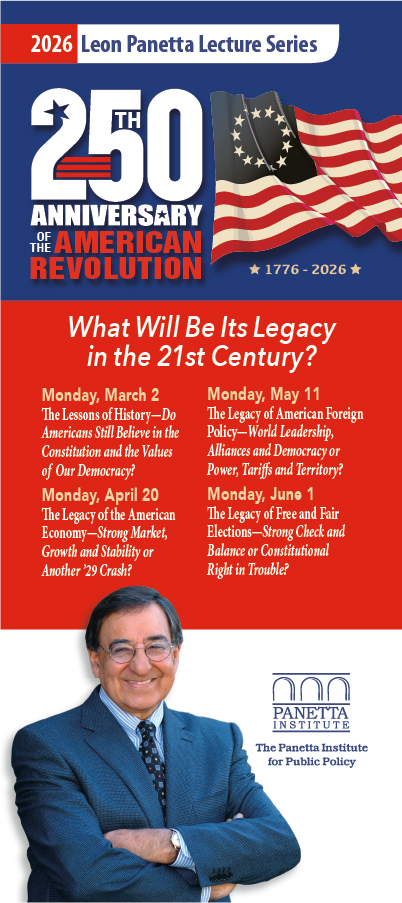
Panetta Institute Announces the 2026 Leon Panetta Lecture Series

The 250th Anniversary of the American Revolution

What Will Be Its Legacy in the 21st Century?

This year’s theme will ask the question The 250th Anniversary of the American Revolution – What will be its Legacy in the 21st Century? Secretary Panetta will moderate each of the sessions. Joining him in these important discussions is an impressive list of speakers to discuss our nation’s history and what it means for our future.

“This year we celebrate the 250th anniversary of the signing of the Declaration of Independence and the formal start of the American Revolution,” said Panetta Institute Chairman Leon E. Panetta. “As we approach this milestone we do so at a time when the unifying spirit behind that brave fight for Democracy is largely fragmented. Today we are a nation deeply divided over economic issues, foreign policy, and our basic democratic values and systems. Can the lessons of the American experiment guide us through these new challenges? Can our economy sustain itself against threats to trade and unpredictable markets? Will the Trump administration’s efforts to create a new world order bring peace or more war? And finally as we approach the mid-term elections how can we protect the most essential democratic right, the ability to vote. I’ll pose these questions to an impressive list of speakers. A dialogue of ideas is more important than ever. ”

The events for the 2026 season are as follows:*

Monday, March 2, 7:00 – 8:30 p. m. The Lessons of History – Do Americans Still Believe in the Constitution and the Values of Our Democracy? with Douglas Brinkley, author and Professor of History, Rice University; Lindsay Chervinsky, presidential historian, author and executive director of the George Washington Presidential Library; Nicholas Kristof, a columnist for The New York Times and Pulitzer Prize winning journalist and Chris Whipple, Emmy-winning documentary filmmaker, journalist, and author.

Monday, April 20, 7:00 p. m. to 8:30 p. m. The Legacy of the American Economy – Strong Market, Growth and Stability or Another ’29 Crash? with Jared Bernstein, Chief of the Council of Economic Advisers (2023-2025); Mitch Daniels, Governor of Indiana (2005-2013) and Director of the Office of Management and Budget (2001-2003); Anja Manuel, former special assistant to the Under Secretary, U. S. Department of State; and Nina Schick, world-leading authority on AI and its geopolitical impact.

Monday, May 11, 7:00 p. m. to 8:30 p. m. The Legacy of American Foreign Policy – World Leadership, Alliances and Democracy or Power, Tariffs and Territory? with Mark Esper; Secretary of Defense (2019-2020); Jeh Johnson, Secretary of Homeland Security (2013-2017); and Wendy Sherman, Deputy Secretary of State (2021-2023).

Monday, June 1, 7:00 p. m. to 8:30 p. m. The Legacy of Free and Fair Elections – Strong Check and Balance or Constitutional Right in Trouble? with Rahm Emanuel, U. S. Ambassador to Japan (2022-2025), Mayor of Chicago (2011-2019) and White House Chief of Staff (2009-2010); Hugh Hewitt, political commentator, journalist for The Washington Post and the Deputy Director of the Office of Personnel Management (1989-1990); Karl Rove, political consultant and White House Deputy Chief of Staff (2005-2007); and Tim Ryan U. S. Representative, Ohio (2003-2023).

Leon Panetta Lecture Series subscriptions include tickets to all four live events and are available for $400. Individual tickets sell for $100. To order a subscription or individual ticket, call the Panetta Institute at 831-582-4200 to pay with a credit card.

For additional information on tickets, subscriptions or broadcast details, please call the Panetta Institute at 831-582-4200.

* All dates and speakers subject to change.

2026 Leon Panetta Lecture Series Sponsors and Co-Sponsors
Thank you for your generous support and leadership in sponsoring this lecture series for our communities. Your gift is an extraordinary public service.

Sponsors:

Beacon Global Strategies

Laurie and David Benjamin

California American Water

The California State University

Cannery Row Company

City of Monterey

Debra and George W. Couch III

Dorian Daley and Michael Krautkramer

Sherry E. DeBoer

Bill and Nancy Doolittle

Eagan Family Foundation

Ronda and Gordon Eubanks

Gail Griggs

Steve Hallgrimson Family Foundation

Hamilton, Rabinovitz & Associates, Inc.

Kaiser Permanente

Stan McKee

Sharon and Stan Meresman

Montage Health

Monterey Bay Aquarium

Monterey County Office of Education

Leon and Sylvia Panetta

Pebble Beach Company

Susan Prest

Toeniskoetter Family Foundation

Kathy and Tom Wiggans

Rhonda Williams and Myles Williams

Stanley Zax

Zenith Insurance Company

Co-Sponsors:

AT&T California

Bank of America

Louis and Jane Castruccio

College of Health Sciences and Human Services at Cal State Monterey Bay

The J. Willard and Alice S. Marriott Foundation


Panetta Institute Survey Shows Record Number of College Students Concerned About the Health of our Democracy — 76% Say They Will Not be able to Achieve the American Dream 82% Believe the President Should Defend and Follow the Constitution

In the Panetta Institute’s 2025 nationwide survey of college students, results show students are deeply concerned about the future of the United States and their own personal prospects for economic security. A record 55% felt that American democracy was not working well, an increase of 9 points from 2024 and a record low in the survey’s twenty-four-year history. Sixty-five percent of college students say that things in the country are off on the wrong track.

“A record number of students are concerned about the health of our democracy and are uncertain and concerned about the future of our country,” said Institute Chairman Leon E. Panetta. “At the same time, we saw a spike in the amount of students who believe politics is relevant to their lives. Young people are dissatisfied with the current leadership and worried about their future, but they are expressing an interest in participating in our democracy to make things better. We believe these results suggest we are at a pivotal time in how we approach this next generation of voters and inspire them to apply themselves to protecting our democracy.”

READ MORE


The Panetta Institute for Public Policy Announces the 2025 Leon Panetta Lecture Series What Will Be the Legacy of the Trump Era? Live, In-Person Events Featuring John Kerry, Bob Rubin, Susan Schwab, Jeff Sessions, Janet Napolitano, Alejandro Mayorkas, Nick Burns, Chris Christie, John Kirby, James Carville and Mary Matalin Among Others

The Panetta Institute announces its live, in-person events for the 2025 Leon Panetta Lecture Series.  Subscriptions are available for the forums, which will take place at the Monterey Conference Center on Monday evenings this spring.

This year’s theme will ask the question What Will Be the Legacy of the Trump Era?  Secretary Panetta will moderate each of the sessions.  Joining him in these important discussions is an impressive list of speakers discussing the new administration’s impact on the economy, the rule of law, foreign policy, and governance of our democracy.

The events for the 2025 season are as follows:*

      Monday, March 17 – 7:00 p.m. to 8:30 p.m.  Tariffs, Tax Cuts, Debt, Inflation – What Will Be the Economic Legacy of the Trump Era? with Christina Romer, former Chair of the Council of Economic Advisers; Bob Rubin, former U.S. Secretary of Treasury; Susan Schwab, former U.S. Trade Representative; and Kevin Warsh, former member of the Federal Reserve Board of Governors.

      Monday, April 14 – 7:00 p.m. to 8:30 p.m.  Constitution, Immigration, Law and Order, Pardons – What Will Be the Law Enforcement Legacy of the Trump Era? with Alejandro Mayorkas, former Secretary U.S. Department of Homeland Security; Janet Napolitano, former Secretary U.S. Department of Homeland Security and former governor of Arizona; Chuck Rosenberg, former U.S. Attorney; and Jeff Sessions, former U.S. Attorney General.

      Monday, May 19 – 7:00 p.m. to 8:30 p.m.   Russia, China, the Middle East, the Panama Canal  – What Will Be the Foreign Policy of the Trump Era? with Nick Burns, former U.S. Ambassador to China; John Kerry, former U.S. Secretary of State; John Kirby,former National Security Communications Advisor; HR McMaster, former National Security Advisor; and Rex Tillerson (invited), former U.S. Secretary of State.

    Monday, June 9 – 7:00 p.m. to 8:30 p.m. Bipartisanship, Gridlock, Checks and Balances, Stability or Chaos – What Will Be the Governing Legacy of the Trump Era? with James Carville, former advisor Clinton campaign; Chris Christie, former Governor of New Jersey; and Mary Matalin, former White House advisor to President George W. Bush.

“President Trump has now entered his second term as president promising a “Golden Age” for America.  He has promised change and issued a record number of executive orders.  His first term saw a great deal of chaos and unpredictability,” said Panetta Institute Chairman Leon E. Panetta.  “Will that happen again or will he provide the leadership to turn crisis into opportunity?  What will be the legacy of the Trump Era?  We will discuss these and other questions related to our economy, law enforcement, foreign policy, and governance of our democracy with our distinguished panel of speakers.”

Leon Panetta Lecture Series subscriptions include tickets to all four live events and are available for $400.  Individual tickets sell for $100.  To order a subscription or individual ticket, call the Panetta Institute at 831-582-4200 to pay with a credit card.

For additional information on tickets, subscriptions or broadcast details, please call the Panetta Institute at 831-582-4200.

*  All dates and speakers subject to change.


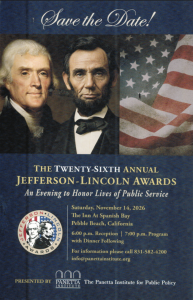
The Panetta Institute for Public Policy Honored U.S. Senators Angus King and Amy Klobuchar and U.S. Representative Mike Gallagher at 2023 Jefferson Lincoln Awards On Saturday November 11, 2023

The Panetta Institute for Public Policy announced the recipients of its 2023 Jefferson-Lincoln Awards. The 2023  annual awards was presented to U.S. Senator Angus King (I) of Maine, U.S. Senator Amy Klobuchar (D) of Minnesota and U.S. Representative Mike Gallagher (R) of Wisconsin.  The honors were  conferred at a black-tie gala dinner held at The Inn at Spanish Bay in Pebble Beach on Saturday, November 11, 2023.

Commenting on the honorees, Institute Chairman and Co-Founder Leon E. Panetta said, “our democracy is under threat.  Political theatrics have taken the place of governing and the victims of this vacuum of leadership are the American people. We need elected officials who understand their responsibility to the American people and to our democracy. The Panetta Institute honors three leaders who put duty before party and have shown the courage and integrity in their stewardship of our democracy.”

The November 11 celebration also served as the premier fundraiser to help support The Panetta Institute for Public Policy and its mission to attract thoughtful men and women to lives of public service, inspiring them to a high standard of conduct and equipping them with the practical skills of self-government.  The gala featured a gourmet four-course meal and award-winning wines.  For more information on purchasing seats for the gala or sponsoring a table call the Panetta Institute at 831-582-4200.


Panetta Institute Survey Shows Students’ Outlook on the Future and the Direction of the Nation are at an All –Time Low

No Longer Believe the American Dream is Achievable

In the twenty-third year of its nationwide survey of college students, the Panetta Institute for Public Policy has found that college students’ outlook on the state of the nation is at a historic low. Deeply dissatisfied with the country’s political leadership, 70% of students believe the country is on the wrong track and a staggering 76% are uncertain or concerned about the future of the country.  Both results are all-time lows in the history of the Panetta Institute Poll.

Students are deeply concerned about the future and the survey results suggest that many have all but given up on achieving the traditional American Dream.  Thirty-eight percent believe they will be worse off compared to their parents, the lowest result in the history of the survey.  Seventy percent of college students believe that it is harder for them to achieve the American Dream than it was for their parents and 38% believe they will be worse off financially than their parents.  At least 3 in 10 college students want to achieve the following, but don’t believe they will be able to do so:  have enough money to retire comfortably (38%); be debt free (33%); own a business (32%); or own a home (31%).  Thirty-two percent of students believe that they will not be able to retire and will instead “always be working.”

Click here for a complete report on this year’s findings.2023 Survey Report (6-2-23).


The theme for the annual Leon Panetta Lecture Series for 2023 was The Presidency and a Divided Congress:  Can They Govern?

Live In-Person Events Featured John Boehner, Douglas Brinkley, Liz Cheney Steny Hoyer, David Petraeus, Bob Gates, Annette Gordon-Reed and Bob Woodward, Among Others

The Panetta Institute announced a return to live in-person events for the 2023 Leon Panetta Lecture Series.

This year’s theme focused on The Presidency and a Divided Congress: Can They Govern?  Joining Secretary Panetta in these important discussions was an impressive list of speakers covering economic issues, foreign policy and defense, partisan politics and history. “After two years of Democratic control of the presidency and both houses of Congress, the 118thCongress returns the nation to the realities of a divided government,” said Institute chairman Leon E. Panetta.  “A single party has controlled the White House and the Congress only three times in the last three decades.  But, at a time when so much is at stake can the nation afford the risks associated with a do-nothing Congress?  Will the Congress act to raise the debt limit and avoid damaging our economy?  Can we avoid an economic recession?  Will the new Congress remain unified in support of the war in Ukraine?  Will the Congress work together and avoid gridlock?  Finally, are there lessons we can learn from history that can guide us forward in this divisive time.  I’ll pose these questions to our impressive list of speakers.”